From Tailwinds to Transformations
Modernizing the Residential Services Operating Model to Drive Revenue in a Challenging Market
- Vladimir Kasparov, Managing Director
- Chris Vasta, Senior Director
- Ethan Carlson, Vice President
After years of strong underlying demand, growth conditions across residential services have become more uneven in 2026. The sector remains supported by the essential nature of heating, cooling, plumbing and electrical services, but low housing turnover, elevated project costs and affordability pressures are creating a more difficult operating environment for many organizations.
Housing turnover remains near multi-decade lows, limiting move-related installation and replacement activity. At the same time, equipment and labor costs continue to rise, while elevated borrowing costs make large replacement projects more difficult to finance. These pressures are contributing to greater customer scrutiny of major purchases and, across many operators, increased interest in repair alternatives, discounts and financing.
Additionally, weather-driven demand varies significantly by geography – milder conditions can reduce emergency call volumes in individual markets, even when national temperatures remain elevated.
Lastly, a tight technician labor market adds another layer of complexity. Recruiting and retaining skilled technicians remains challenging in many markets, while operators must also avoid adding capacity that becomes underutilized during seasonal or localized demand slowdowns. Together, these conditions are increasing the importance of disciplined demand generation, call-center conversion and field-capacity management.
A New Model for Driving Revenue
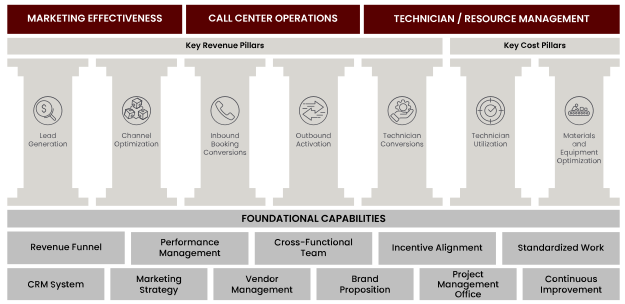
To drive revenue amid these headwinds, operators and sponsors, particularly those in the process of scaling up a portfolio, must invest in both effective marketing strategies that drive qualified demand and sophisticated execution capabilities, especially smarter call center operations and technician and resource management, to meet that demand while preserving margins. Organizations that manage these functions as an integrated revenue and capacity system will be better positioned to win market share, protect margins and continue growing. Importantly, they will also insulate themselves against complacent overreliance on outsized market demand.
However, these operating pillars must also be anchored by standardized processes, aligned incentives, consistent data and a performance management cadence that connects marketing investment to specific key performance indicators (KPIs) such as appointment conversion, field capacity, completed jobs and profitability. In particular, maintaining a well-governed and legible data inventory will be crucial to the success of these efforts. Residential services leaders will need to understand both current and historical trends in order to best direct their spend and measure the return on investment (ROI) of new updates or initiatives. Establishing this foundation is the first step in the modernization process and can act as an enabler for the rest of these improvements.
Effective Marketing
Residential services companies must establish a market presence in an increasingly crowded and competitive industry. Many, if not most, residential services sales originate from inbound calls. Effective marketing is therefore critical for driving qualified demand.
Marketing teams need to understand both longtime and emerging customer pain points, as well as which channels generate leads and which sources produce the most booked appointments, completed jobs and profitable revenue. Without targeted marketing direction, companies risk increasing spend without improving conversion rates.
Achieving this sophistication requires effective tracking that helps companies understand return on ad spend (ROAS) dynamics and identify the advertising channels that are best suited to reach a desired customer base, while carefully managing budgets to avoid overspending that could lead to margin loss.
Conducting regular efficacy audits of both ads and ad channels will enable better direct spending and prevent overpaying for ineffective or expensive ads that cost more than the leads they generate.
For example, smaller residential services companies, having previously served a narrower audience, may be accustomed to relying on print or radio ads. After consolidating, these companies may retain a culture that gravitates toward those familiar mediums, but local print or radio spots will likely not suffice for larger entities.
However, ROAS is not the only metric that matters. To achieve ambitious growth targets, some residential services businesses invest in ad channels that offer lower ROAS but still generate profitable revenue growth. Businesses should aim not to maximize ROAS alone, but to drive profitable growth across the marketing mix. For example, a residential HVAC company might invest in broad-reach connected TV or streaming ads that deliver a modest 2x ROAS, compared to 6x from branded search. But those channels have the capacity to reach new homeowners who were not already searching for HVAC services, fueling incremental job volume and long-term customer growth.
A Smarter Call Center
Call centers serve as the primary point of sale for residential services companies. They are a cornerstone of overall operations and the middle ground between exposure and revenue. Success depends on operators’ ability to both interpret and address caller needs, scheduling the right appointment to resolve a given issue.
In a softer market, every missed call or mismatched request represents lost revenue and potentially wasted marketing spend. That means operators must be equipped to address increased customer concerns about pricing, financing and whether to repair or replace equipment. Scripts, training and incentives should reward consistent communication and a track record of scheduling appointments with technicians who are well-matched to meet the customer’s needs.
Just as they must monitor their marketing efforts, large residential services companies must put concrete systems in place to measure both individual operator and overall call center success. Those systems should track performance against specific KPIs and call center management should be held accountable to those metrics. Top call center KPIs to consider may include:
- Tracked leads by source, service line and geography
- Speed to answer and call abandonment rates
- Lead-to-appointment conversion rates
- Appointments scheduled
- Cancellations and no-shows
- Assigning the right technician to meet unique customer needs
- Completed jobs and related revenue generated
- Customer satisfaction levels after a scheduled appointment is complete
Leaders should standardize KPIs and data gathering tools across all call centers, with strong data governance in place to keep information organized and accessible and facilitate efficient analysis. This data can also feed back into marketing efforts, by tracking the sources of new leads and measuring marketing strategy effectiveness.
Residential services companies should also consider how best to organize call center operations. Models can vary between consolidated and distributed networks, with some companies preferring centralization while others may opt for a distributed network to better address geographic specific needs. For example, a centralized call center in Jacksonville, Florida, may not fully understand the needs of residents in Miami, Florida. However, a centralized call center could make data monitoring and performance tracking easier. In both models, leadership should prioritize the ability to generate and analyze data to drive strategic decision making.
Efficient Technician and Resource Management
Technicians are among the most valuable resources residential services companies possess. They are often the ones in the field closing a sale, identifying cross-selling opportunities and turning one-time customers into repeat clients. Smaller companies with fewer branches or limited footprints may be able to function with fewer formal technician management structures, but larger organizations must implement robust systems and processes to govern technician training, utilization and retention.
Ongoing labor constraints heighten this imperative. Technician shortages can limit the volume of work a company can perform, increase wage pressure and contribute to longer customer wait times. At the same time, over-hiring ahead of calmer weather and lower emergency call volumes can leave available technicians underutilized in certain markets or periods, increasing both costs and attrition. A unified, data-backed view of regional and seasonal demand, technician availability, skill sets and geographic coverage enables leadership to strike the right balance.
Additionally, performance tracking can help companies determine how to best assign each individual technician and help call center operators deploy the right technician for each specific customer need. Where some technicians may excel at installations, others might demonstrate an aptitude for maintenance work and related customer service. Companies should consider investing in training to help technicians identify and pursue further cross-selling opportunities as they interact with customers. Because customer contact points are limited and predominantly inbound, on-site technician visits are valuable opportunities to offer customers expert service explanations and additional services – conveyed in person by a friendly face instead of an impersonal ad.
Given the value technicians provide, residential services companies that are currently scaling up should heavily prioritize technician retention. Constantly changing policies, shifting performance metrics or management structures can lead to talent attrition just as much as a lack of available work. Even highly effective advertising is unlikely to overcome insufficient knowledge and talent.
To combat attrition, organizations should tailor change management communications to emphasize new opportunities available to technicians, such as enhanced training and development. More importantly, companies must ensure technicians are provided with a consistent stream of work. Because technician pay structures are often based on completed work, companies that do not provide enough work risk seeing technicians depart for businesses generating more demand and offering a higher volume of jobs – and therefore higher pay. This reality should also serve to underscore the importance of effective marketing and responsive call centers, as underperformance in either area could lead to demand falloff and increased technician attrition.
The Portage Point Approach
Residential services organizations can no longer rely on the essential nature of their products and services to drive growth. With a softer market raising the costs of fragmented execution, companies must begin a holistic modernization of their marketing, call center operations and technician management processes. A breakdown in one area affects the entire revenue system.
Portage Point works with private equity (PE) sponsors, lenders and founder-owned residential services businesses to optimize critical functions, address scaling challenges and elevate operations. Our integrated approach begins with a root-cause assessment of demand generation, conversion and field execution and leverages these insights to design and implement fit-for-purpose solutions that strengthen accountability across the organization and translate operating improvements into lasting, measurable value.
Contact our experts to discuss driving value across your residential services portfolio.