The Long Tail Trap
How SKU Proliferation Erodes Consumer Portfolio Value
- Tosh Dhanalal, Managing Director | Head of Consumer Investment Banking
- Arun Lamba, Managing Director
- Peter Mangan, Managing Director
Stalled revenue, aging inventory and stretched cash conversion cycles strained consumer categories in the first half of 2026, pointing to an increasingly common issue – product assortments have grown beyond what businesses can profitably support.
The past decade, especially the post-pandemic years, saw aggressive stock keeping unit (SKU) expansion as e-commerce removed the physical shelf as a natural constraint and marketplace channels rewarded catalog breadth with algorithmic visibility. Each new colorway or existing model variation promised upside.
That equation has changed. The same incremental SKU economics that made the long tail look attractive are now creating margin pressure, working capital drag and operational complexity. Each incremental product requires forecasting, procurement, warehouse space, listing maintenance, marketing support, channel management and eventual disposition. When demand slows or becomes uneven, those requirements turn revenue optionality into margin compression and trapped working capital.
For private equity (PE) sponsors with consumer portfolio companies, this pattern warrants close attention. The signals often hide in plain sight, the damage compounds quietly and the window for a controlled recovery narrows faster than most management teams expect.
This article examines how SKU proliferation can cause hidden value leakage, the warning signs sponsors should monitor and how a focused 30, 60 and 90-day recovery framework can restore control across operations, liquidity and strategic optionality.
Where SKU Economics Break Down
The economics of an overextended assortment break down at the SKU level before the damage is obvious in the aggregate profit and loss (P&L). A product can still generate revenue and appear strategically useful while failing to cover the full cost to forecast, buy, store, list, promote, fulfill and eventually mark down or liquidate.
Low-velocity SKUs consume operating capacity disproportionate to their contribution, especially when they are positioned across multiple channels with different fee structures, service requirements and markdown risks. A slow-moving SKU with three months of turn can consume up to 20% of its annual wholesale value once warehousing, pick-and-pack and markdown exposure are fully loaded
When that burden is multiplied across hundreds of marginal products the issue is no longer assortment complexity alone. It becomes trapped cash, diluted margin and reduced support for the core SKUs that actually drive value.
Several conditions have intensified that pressure in 2026
- Non-premium discretionary categories remain soft as middle market consumers, the core buyers for many sponsor-backed brands, trade down or defer purchases.
- Warehouse rates, fulfillment fees and inventory financing costs have not returned to pre-2021 levels.
- Wholesale partners are pushing back on assortment breadth, tightening payment terms and returning inventory more aggressively.
- In saturated categories, fewer than one in four SKUs launched during the prior two years reaches minimum viable velocity by month six.
- Each launch consumes forecasting, procurement, listing and marketing resources even when the SKU never reaches scale.
The inflection point is rarely dramatic. The gap between expected assortment contribution and actual performance can widen gradually for years.
Five Signals Sponsors Should Examine
The following indicators, when viewed together, suggest an assortment problem that has likely begun to impair working capital.
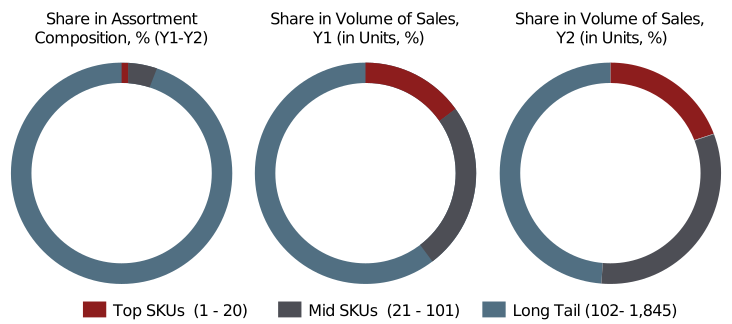
1. Intensifying Sales Stratification
In one recent engagement, the top 18% of SKUs generated 91% of revenue while the bottom 300 SKUs consumed more than 35% of warehouse capacity. If the top 20% SKU share of revenue is growing year over year, the tail is expanding relative to the core.
2. Consistent New Product Launch Underperformance
When SKUs launched during the last two seasons require a full year to approach minimum viable velocity, the innovation pipeline has shifted from growth driver to working capital drain. Sponsors should also assess cannibalization within the existing assortment, especially when new launches receive disproportionate marketing budgets.
3. Accelerating Inventory Aging
Inventory aged more than 180 days is a reliable proxy for demand planning discipline relative to assortment complexity. A growing aging bucket creates both balance sheet pressure and future margin risk.
4. Lengthening Cash Conversion Cycles Without Revenue Offset
A business with 600 SKUs may carry more than 90 days inventory outstanding. After rationalizing to roughly 250 core SKUs, that same business can normalize to 52 days inventory outstanding within two quarters. When days inventory outstanding rises and days payable compresses, the business is destroying free cash flow even if revenue appears stable.
5. Deteriorating Omnichannel Execution
Fill rates, on-shelf availability and listing health scores decline when assortment complexity exceeds operational bandwidth. When a business cannot reliably service its best SKUs because resources are spread across hundreds of marginal items, the periphery is damaging the core.
The question for sponsors is not whether these dynamics exist, but rather how far the business has already moved along the deterioration curve.
A Phased Recovery Framework
Sponsors can assess assortment complexity through a focused 30-, 60- and 90-day recovery framework. The objective is not simply to cut SKUs, but to restore visibility, contain working capital leakage, align the assortment with channel economics and reset the operating discipline, key performance indicators (KPIs) and incentives that allowed the long tail to build.
Days 1 to 30 – Build the Fact Base and Contain the Tail
The objective for the first 30 days is containment. Sponsors should push management to build a granular SKU-level view of current velocity, contribution, warehousing cost, fulfillment burden, markdown exposure and working capital drag. The assortment should then be ranked according to economic contribution, with clear quantitative thresholds for continuation, transition and discontinuation.
The path for transitional inventory should be defined in advance, including liquidation channels, timing windows and acceptable margin floors. Rationalization often needs to move faster than management prefers, but delay allows aged inventory, markdown exposure and working capital pressure to compound.
Priority Actions for Containment
- Conduct SKU-level cost and contribution analysis.
- Establish SKU and inventory quantitative continuation, transition and discontinuation criteria.
- Define liquidation and transition paths for discontinued SKUs.
Days 31 to 60 – Align Assortment with Channel Economics
Rationalizing what the business sells is inseparable from rationalizing where it sells.
On Amazon, a long tail of low-velocity Amazon Standard Identification Numbers (ASINs) can consume advertising spend while creating excess Fulfillment by Amazon (FBA) inventory fees and aging surcharges. The discipline is to define a tighter Amazon-native assortment built around hero SKUs with proven conversion rates and margins that can absorb the platform fee structure. Items that do not meet that threshold are diluting value.
Wholesale and dropship decisions also require separate treatment. Wholesale commitments should focus on a high-conviction core with proven sell-through because markdown risk sits with the seller. Dropship eligibility can extend further, but only to operationally reliable SKUs. An undifferentiated assortment across both fulfillment models can accelerate working capital deterioration.
Seller alignment also matters. Some partners are moving toward more narrow, curated merchandising online and in-store. Others are expanding selection. Both can be effective distribution partners when the consumer brand makes informed channel decisions and understands the risks.
Priority Actions for Assortment Alignment
- Define channel roles across retail, e-commerce, wholesale, marketplace, dropship and social commerce.
- Establish SKU placement criteria by channel, including assortment role, velocity and tenure thresholds.
- Set SKU placement, withdrawal and liquidation KPI thresholds by channel.
Days 61 to 90 – Reset Incentives, KPIs and Operating Discipline
Assortment proliferation is often a symptom of organizational incentives as much as strategy. Product teams may be rewarded for launching rather than sustaining SKUs. KPI frameworks may track gross adds instead of net contribution, margin or cash conversion.
A daily dashboard focused on SKU velocity, inventory aging and cash conversion gives leadership the early warning visibility many businesses lack.
Priority Actions for Operating Discipline
- Implement daily SKU, inventory and cash dashboard reviews.
- Transition to real-time working capital management.
- Realign leadership incentives around net contribution, margin and cash conversion.
- Ensure end-of-lifecycle planning is embedded in the product management discipline.
Controlled Rationalization in Practice – Consumer Goods Company Reduces Assortment by 50%
A non-perishable consumer goods company reduced its assortment by more than 50%. The discontinued items represented roughly 10% of total revenue but consumed an outsized share of working capital, warehouse capacity and management attention.
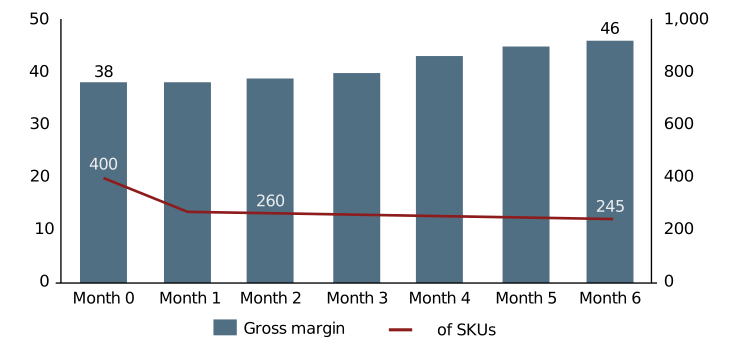 |
The near-term impact can feel counterintuitive. Revenue may dip As inventory turns accelerated and aged stock was liquidated, cash |
An Integrated Approach to Preserve Value
For Sponsors, the relevant question is not whether consumer portfolio companies have assortment problems. A meaningful share do. The question is whether Sponsors have the visibility to determine which businesses are hovering early in the deterioration curve and which require urgent, complex intervention.
The Long Tail Trap is rarely solved through operational cleanup alone. By the time working capital pressure is visible at the portfolio level, the business may also face balance sheet pressure, operational restructuring needs and strategic alternatives that must be pursued in parallel.
Those alternatives may include organic recovery, refinancing or a sale process. Each path requires distinct execution, but the workstreams should be coordinated rather than sequenced.
The Portage Point integrated advisory model is designed for these situations. Our team delivers financial and operational performance improvement and investment banking expertise through one integrated effort. This helps compress the recovery-to-positioning timeline and reduce the coordination risk that can impair value when workstreams are siloed.